

Russian House “Rodina”
Across
the Years
The tragic yet sublime fate of Russian
emigration left its intricate imprint on the history of the Society.
Its echo
is still reverberating and manifesting itself in the well-composed and
laconic
Russian language spoken by the local old-timers, in the marvellous old
Russian
harmony of the Divine services in the nearby
It all began in the
It’s interesting to note that not far away from
The settlers gradually cleared the virgin
lands, built their houses and founded small villages giving them their
family
names or names of events with which they connected the place. Most
often the
main income of the immigrants came 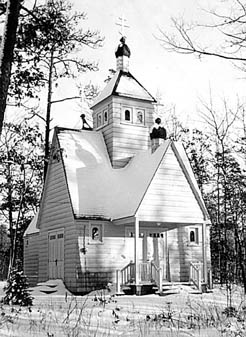 from farming and, in particular, from raising
chickens.
from farming and, in particular, from raising
chickens.
In the 1930s a group of Russian settlers (18
persons), the majority of whom were Cossacks, decided to form a Church
community. Among the founders were: L.A.Sinkler,
V.V.Pozhidaev,
P.K.Grigorovich-Barsky, V.M.Azhoghin, V.G.Grekov, V.T.Yuritsyn,
E.E.Bobrovnichy
and others.
At that time Dr. A.V.Plavskaya together with
her mother decided to set up a country house – a sanatorium (health
center).
With that idea in mind they bought a large plot of land (5 acres, about
2
hectares). But in a short while they decided to donate it to Archbishop
Vitaly
(Maksimenko) who was then the Diocesan bishop providing spiritual
leadership to
the people of this area. His Eminence Vitaly seeing the needs of a
newly-born
Russian community, felt it impossible to use the donated land for the
purpose
of the country house – sanatorium - and gave the deed to the parish.
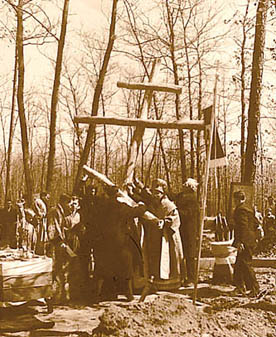
The rite
of laying the foundation for the new church took place on March 31,
1936. The
celebration was headed by Archbishop Vitaly and at that time an oak
cross was
installed. During the ceremony the Archbishop said: “I pray to God that
this first-born
of mine should bloom as “the tree righteously planted near the waters”.
The
church and the parish were dedicated to
The first contribution to the church
construction fund in the amount of 500 dollars was made by Dr.
Plavskaya. Other
poor families managed to collect 200 dollars more and with these meager
amounts
started to build the chapel initially and then (in 1938) the church it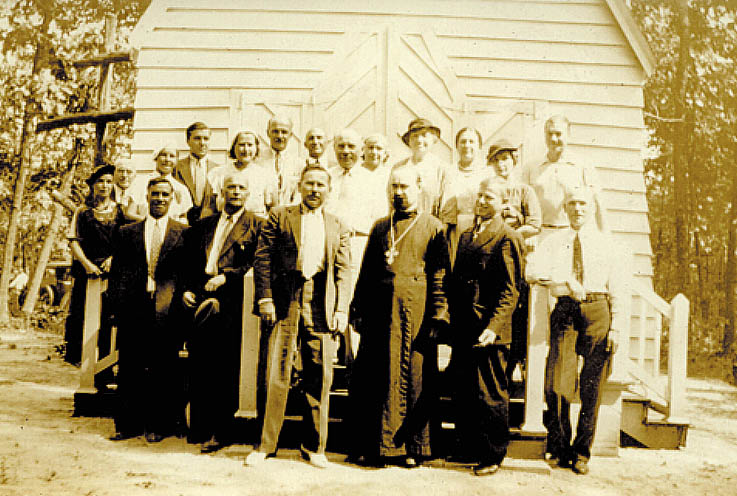 self. The
layout of the chapel was designed by V. Zavalishin who took into
account its
further restructuring as a church. The stoic endeavors of the “Russian”
self. The
layout of the chapel was designed by V. Zavalishin who took into
account its
further restructuring as a church. The stoic endeavors of the “Russian”
In the years to come the parish grew by leaps
and bounds. In 1938 the church was enlarged for the first time and in
1948 it
was enlarged for the second time. The Great Consecration was performed,
as was
done previously, by Archbishop Vitaly Maksimenko. Subsequently, the
church was
enlarged twice more and finally acquired the appearance that we see
nowadays,
but under another name. The parish was growing too, as well as that of
its
social life. The construction activity went on and in 1940 the
dedicated parish
house was completed and it was used for such cultural and charitable
institutions as association of sisterhood, drama circle, library,
department of
aid to children in emigration, Russian invalids’ aid representa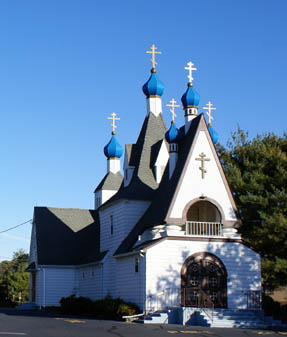 tion
office,
department of Russian-American union for the Soviet Union refugees
protection
and help, Foundation for the DP aid in America, Vladimir Society
bureau,
anticommunist center bureau etc.
tion
office,
department of Russian-American union for the Soviet Union refugees
protection
and help, Foundation for the DP aid in America, Vladimir Society
bureau,
anticommunist center bureau etc.
On the September 12, 1989, on St. Alexander
Nevsky feast day, the foundation for the new
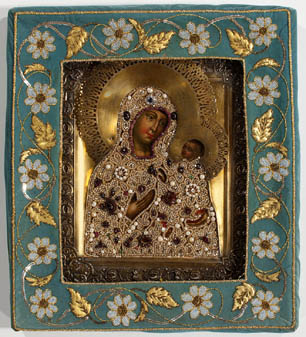
After the Great consecration of the new St.
Alexander Nevsky Cathedral, the old church, with the blessing of the
ROCOR
Hierarchal Synod, was renamed in honor of the icon of Our Lady of
Tikhvin. This
icon is known in the parish as “The Royal” because once it belonged to
the Empress
Alexandra Feodorovna of 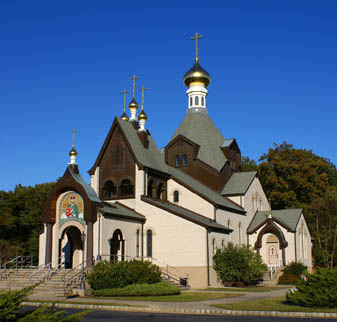 o the St.Alexander Nevsky
church where it is currently retained. On the June 9, 2011, the altar
of the
initial church in
o the St.Alexander Nevsky
church where it is currently retained. On the June 9, 2011, the altar
of the
initial church in
From the very beginning the parish paid great
attention to the education and upbringing of children. The first 12
students
started regular attendance at classes in the parish school in November
1941.
Initially the lessons were held in the parish house, but by 1961 a
school was
built for 5 classes and in 1973 a school building for 10 classes was
commissioned. The number of pupils totalled 120 children. The school
exists to
the present day and is open once a week on Saturdays. The following
school
subjects are taught: Law of God (Catechism), the Russian language,
Russian
literature, Russian history, geography as well as music and
choreography. But
most importantly, the children are taught the spirit of the Orthodox
brotherhood,
the correct attitude towards material goods and Christian love for
their fellow
creatures. The parish grew and developed, but it did not necessarily
follow
that its ecclesiastic and social lives went hand in hand. The stumbling
block
turned out to be certain cultural and entertainment activities on
Saturdays. The
church authorities were against Saturday entertainment, even banning
some of
the most ardent 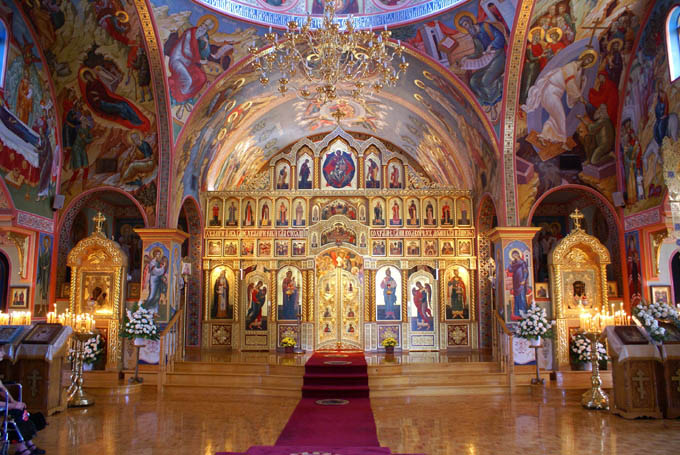 enthusiasts. But at the same time the Lakewood
old-timers
thought that Saturday was the only day of the week for them to meet
each other,
dance and enjoy themselves because the rest of the week they worked
hard to
earn their living and to make ends meet. Besides, the Cadet’s tradition
was to
give Balls on Saturdays and there were many Cadets not only in the
vicinity but
also among the parishioners.
enthusiasts. But at the same time the Lakewood
old-timers
thought that Saturday was the only day of the week for them to meet
each other,
dance and enjoy themselves because the rest of the week they worked
hard to
earn their living and to make ends meet. Besides, the Cadet’s tradition
was to
give Balls on Saturdays and there were many Cadets not only in the
vicinity but
also among the parishioners.
In June 17, 1954, a group of parishioners, (78
persons) met in a private house and decided to constitute a cultural
and educational
Society which later was named “Rodina” (“Homeland”). On September 26,
1954, the
first constitution meeting was held in a
From the very beginning the activity of the
newly founded cultural Society “Rodina” was intermingled with that of
the
parish. But from time-to-time there were difficulties in the
relationship with
the ecclesiastic authorities which resulted in bitter
misunderstandings.
Nevertheless, it was a community of Russian people troubled and feeling
unrest
for the fate of
The “Rodina” Society has undertaken most of the
parish’s social and charity activities. It housed drama performances,
musical
recitals of outstanding artists (S.Zharov Chorus, the singer S.Gedda,
violinist
Polina Shuster, ballet dancer N.G.Raevskaya etc), there were M.A.
Lermontov
“Art Studio”, Ya.V. Rzhevsky sports club “Vityaz”, “Youth Club” where
one could
choose from table tennis, chess, recitation, drawing, handcraft,
old-time
dances, wood carving and many other sections. By invoking the past, the
enthusiasm and common spiritual awakening of the Russian community that
found a
new “Homeland” overseas, worked wonders. Grand Duchess Vera
Konstantinovna
Romanova, the younger daughter of Grand Duke Konstantin
Konstantinovitch
visited the Society on many occasions.
It is particularly worth noting that the
“Rodina” 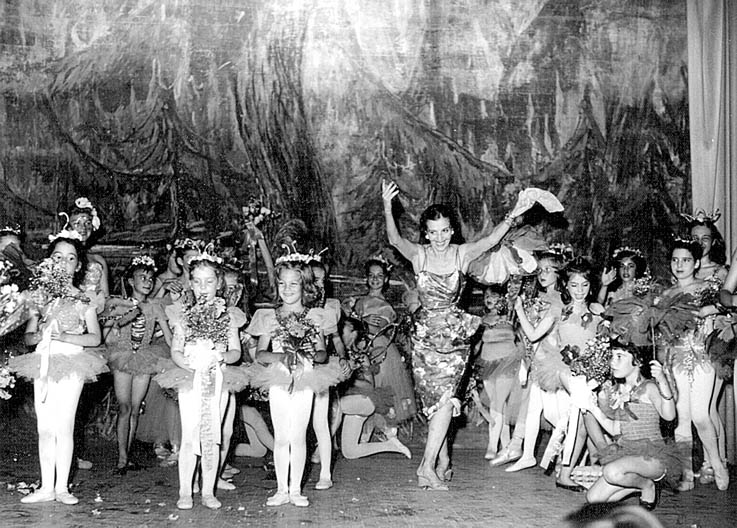 Museum, housing by that time some 40,000
objects,
was transferred to
Museum, housing by that time some 40,000
objects,
was transferred to
As we have noted, at the beginning Society life
was closely connected to that of the parish. But as time went by these
ties had
became weaker and occasionally there were serious conflicts between the
parish
and the “Rodina” Society leaders. Another problem was due to the
discord
between the older generation and the young people regarding the
management of
the Society and the choice of programs. The Society founders grew older
but
there was no successor from the younger generation to take the reins of
leadership. Consequently, it resulted in
a decrease in Society members and a decline in the cultural activity.
After the
Museum, the largest Russian History Museum in the USA, was transferred
to
Russia, Society activity became progressively less from year to year
and in
recent years its activity was reduced to “Bingo” games, New Year’s Eve
celebration (31st December) and family holidays.
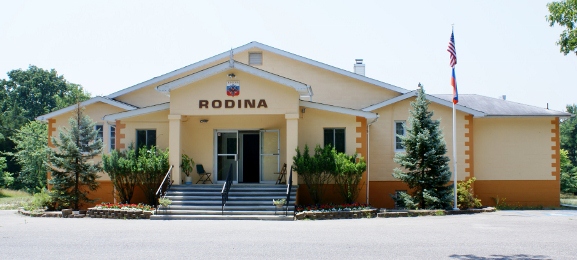
In winter 2011 the “Rodina” Society Council of
Elders decided to sell th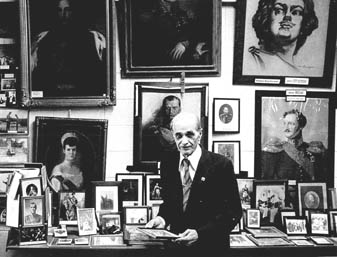 e building along with the land. The contract
was fully signed on January 5,
2012, and
the building of the “Rodina” Society with its land (12.4 acres) passed
into the
ownership of the Russian House “Rodina”.
e building along with the land. The contract
was fully signed on January 5,
2012, and
the building of the “Rodina” Society with its land (12.4 acres) passed
into the
ownership of the Russian House “Rodina”.
The name of the organization includes the word
“Russian” which implies “Orthodox”. It has been decided that the
activity will
be correlated with the Orthodox Church and the Russian House welcomes
all
interested persons with different cultural, ethnic and religious
backgrounds as
well.
It has been decided to pay great attention to
the
activities aimed at children and youth.
Adults will have the opportunity to attend the
exhibitions, recitals, festivals, drama performances, balls, dancing
and other
recreation activities, to celebrate birthdays, marriages etc.
The lectures,
presentations,
films and chamber music performances will be  held
in the small cinema
and
conference hall. The Russian House “Rodina”
is
actively commemorating our outstanding compatriots: there will be “The
Park of
Glory”, a museum in the open air, with sculptures and monuments to
honor prominent
persons of culture, religion, science, the military and statesmen. Provisions
have been made to build a chapel in commemoration of the warriors who
perished
in battlefields for the freedom of
held
in the small cinema
and
conference hall. The Russian House “Rodina”
is
actively commemorating our outstanding compatriots: there will be “The
Park of
Glory”, a museum in the open air, with sculptures and monuments to
honor prominent
persons of culture, religion, science, the military and statesmen. Provisions
have been made to build a chapel in commemoration of the warriors who
perished
in battlefields for the freedom of
A huge amount of
work
remains to restore the building and to renovate the land, to renew the
museum
and the library, but the most important task is to unite people who
love and
appreciate their own culture!
Each
of us has a desire to preserve, multiply and transmit to
future
generations the
cultural heritage of their ancestors.